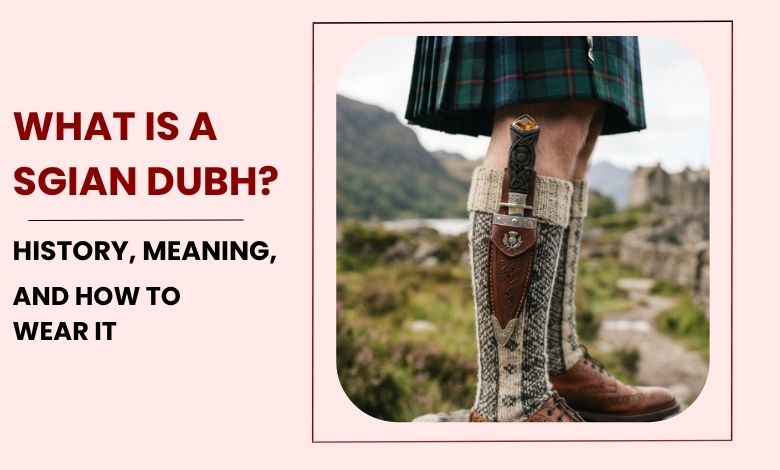
The Sgian Dubh is among the most well known of the Highland accessories, as well as being a very unique one. This petite knife is now an iconic element of Scottish history & dress and sits securely in the top of a kilt hose. Today even this is known to be the piece of furniture but it is connected with the year of Highland tradition to have a deep connection. It is not merely about having a showpiece. If you are going to attend or getting ready for a wedding then you must know what Sgian Dubh really means and how it is important as well.
What Is a Sgian Dubh?
As stated above, the name means “Black Knife” and has the pronunciation of BLECK-neef. Sgian Dubh is formed from Scottish Gaelic words, sgian — knife, dubh — black/dark.
The genealogy of the name is not definitively clear, but it is believed that this name could reflect the dark-colored handle of the knife, which was usually fashioned of black wood or antler, or the notion of a hidden weapon. Whatever the source of such a name, it has been so associated with the small ceremonial knife worn as part of Highland dress today.
Pronunciation and meaning of the name (“black knife”)
A Sgian Dubh is a small single edged knife, usually three to six inches, although they are allowed to be as small as a finger nail. Modern specimens typically have handles made of wood, antler, resin or polished materials, and often have tops mimicking the pattern or stones set into them.
Basic description — size, shape, where it’s worn
The Sgian dubh is used differently from larger Highland knives, and there is only the top part of the blade over riding the top of the kilt hose, leaving the lower portion concealed under the kilt. This gives its traditional Scottish look, which is now a characteristic feature of Highland attire.
How it fits into the full kilt outfit
In the modern era, many ceremonial Sgian Dubhs are made using a blunt or decorative blade but still using the traditional seat design, so that they are suitable for formal occasions, but still maintain the traditional look.
The History of the Sgian Dubh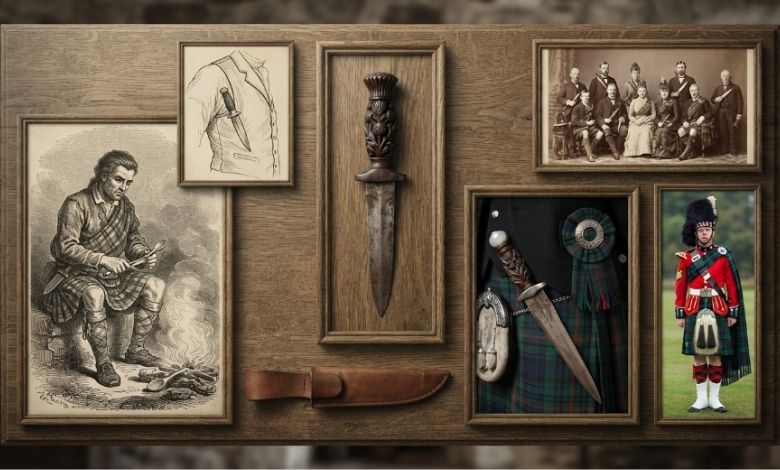
Origins as a concealed Highland weapon
The Sgian Dubh was more than just a ceremonial accessory – it was used for a very practical purpose before. The Highlanders used miniature knives for daily use, such as food preparation, small knots, mending gear and many other common activities. A knife was a necessary weapon in those days and it was just another handy item.
The knife being small could easily be tucked up in clothing without being noticed but still freely available when going for a walk or using a hands-free automobile.
The “sgian achlais” (armpit knife) and its connection
The “Sgian Achlais” is a term that people sometimes use to describe an armpit knife.The “Sgian Achlais” refers to an armpit knife and is a term used from time to time.
A few historians say that the Sgian Dubh evolved out of an earlier concealed knife which was called the Sgian Achlais, the “armpit knife. Kept beneath the arm or inside clothing so travellers didn’t have to carry it around.
Shift from hidden weapon to visible, socially accepted accessory
After Highlanders went to someone else’s house, gentlemen’s men had to demonstrate if there were no hidden weapons inside. Do not disarm them completely; take out the hidden knife and put it somewhere visible that is showing that they are not a threat or that they were being helpful in a peaceful manner.
The visible place was eventually placed to the end of the “kilt hose” and then once that position would see the knife still within view, it would not appear menacing. Eventually this culminated in the tradition in place today.
The Sgian Dubh had little need for its defensive role and eventually lost it altogether as Scotland became more peaceful and guns were more efficient than knives as weapons. Instead, it became a representation of Highland identity and traditional clothes.
The use of the knife openly indicated a thing to wear good horsemanship, good manners and good morals on the part of the Highland gentleman. The knife went from being a common household item to an acceptable cultural prop.
Role of Queen Victoria and 19th-century Highland revival
There was a revival in Scottish culture in the 19th century. However, after repealing the previous bans on tartans, kilts, traditional accessories and Highland dress, this style saw a revival of great impact.
After buying Glasgow’s Balmoral Castle, Queen Victoria did much to popularize the Highland traditions. Her love for Scotland spread this passion to a section of the British nobility and they began to wear Highland clothes for formal occasions, making the Sgian Dubh an accepted part of Scottish traditional dress.
The sgian dubh in military Highland regiments
The tradition was also maintained by the Highland regiments of the British army. The association of the Sgian Dubh with honour, discipline, and military tradition was further strengthened by the decorating of soldiers wearing the badge on top of the formal uniforms of famous regiments from Scotland.
In modern times, many military parades, and Highland ceremonies still practice the Sgian Dubh as part of formal Highland dress uniform.
The Meaning and Symbolism Behind the Sgian Dubh
While not commonly used as tools, there is still a great deal of symbolic value attached to modern Sgian Dubhs.
The knife is a symbol of courage and self-reliance to many wearers, as well as hospitality and respect for Highland traditions. The fact that it is visible, mirrors the historical feeling and display of peaceful intentions while maintaining awareness of readiness and independence.
The Sgian Dubh has symbolism also of Scottish traditions. It can be worn for cultural heritage or as a symbol of the tradition of Highland culture, which has been observed for many centuries and is still followed today in many parts of the world. Some contemporary designs incorporate Celtic knots, thistles, clan crests or Scottish national emblems, placing this historical addition to the wardrobe yet an additional bite into the tail.
How to Wear a Sgian Dubh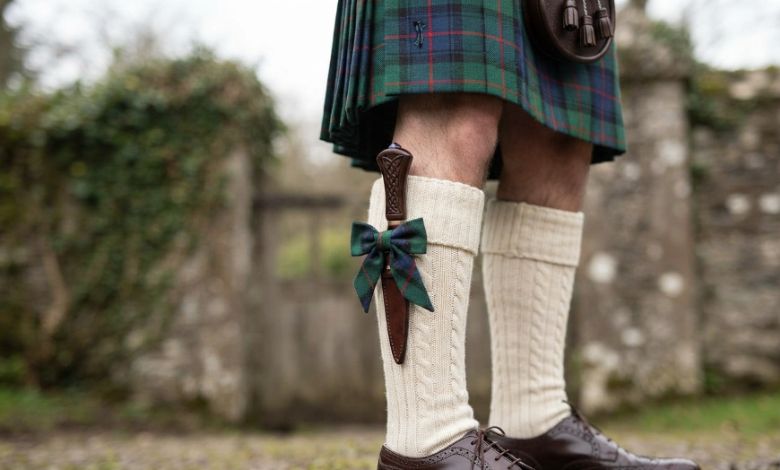
Correct placement
In the traditional type of kilt the Sgian Dubh is worn in the right kilt hose, such that just the top part of the handle can be seen above the folded kilt hose. This keeps the blade as much as exposed as possible, but most of it is kept in the sock.
How it should fit proportionally to the sock’s flash/garter pocket.
Usually the Sgian Dubh is placed next to the garter flashes, not underneath them. Keep about one-third of the handle above the top of the hose.
How it should sit in relation to the sock flash/garter
It should not lean too far and keep a good position from slipping down the sock any further. Making sure they are all properly positioned, gives them a tidy and balanced appearance, which complements the remainder of the Highland outfits.
Matching the sgian dubh to the rest of the outfit
The Sgian Dubh should fit in with the rest of the array of Highland accessories. Black leather handles complement formal evening attire, whereas natural wood or antler handles are suitable for more classic or rustic looks.
Metal fittings can also sync with the kilt buckle, kilt pins, sporran cantle, cufflinks and other accessories to produce a uniform look. These are little, but important, things that can add to a well-thought-out and refined look.
Etiquette to wear
While old fashion is everywhere in Sgian, it is still a good idea, as well as following the local laws, to treat people with respect. Most ceremonial cuts have a knobbed end on the blades or they are only decorative, so they may be chosen for wedding and large events.
If you are travelling, visiting public venues or entry to government offices, airports or sporting events, always check local rules with respect to knives! Some places may not allow any ceremonial blades whatsoever!
Why Customers Prefer to Purchase From Our Scottish Kilt Store
We can understand why customers choose to buy our products.We can see why the customers like to go for the purchase in our store. Just like selecting the right kilt or sporran, it is crucial to choose the best Sgian Dubh. At Scottish Kilts Store, we create Sgian Dubhs that are both well-made and traditionally shaped in the Highland style.
From black handled styles to Celtic pieces, decorative stone tops, and pieces that compliment formal and casual Highland outfits we have the perfect choice to match your fashion of the moment. Each piece is carefully made to be both good quality and long-lasting and to fit the original design.
Customers also frequently enjoy having all kilt accessories and buckles available, such as the kilt pins, sporrans, buckles, flashes and kilt hoses, so they can complete their Highland outfit without stressing out about a complete outfit.
Conclusion
It’s one of the smallest accessories of Highland dress but its ballad has a very interesting past. It has a long history of Scotland and is now recognized as an integral part of the country’s cultural, hospitality, and tradition, from its beginnings as a weapon used behind the scenes to its current role as a ceremonial object.
Today it would be more a matter of preserving Highland heritage, properly and respectfully, rather than carrying a blade. Combined with the rest of your kilt ensemble, this piece can create an authentic and timeless look.